
Your Best-Performing Google Campaigns Just Got More Expensive
Here's what changed with Google's bid targets on August 17th, and what to do about it.

What Changed
On August 17th, Google made a significant change to how its bidding systems work. Any campaign that's limited by budget and uses a Target CPA or Target ROAS bid strategy will now perform more consistently toward the actual bid target you set, even when you adjust your budget. The change is intended to remove uncertainty around budget increases and how they may impact performance, providing advertisers with more consistent results.
The Risk
Before this update, budget-limited campaigns would often outperform their targets, and Google let them keep doing it. That is no longer the case.
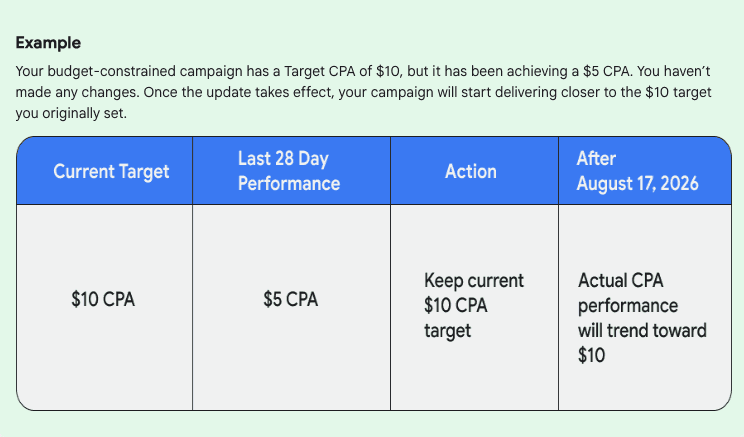
Let’s walk through an example:
— Your target CPA is $10, but your campaign has actually been converting at $5.
— Before August 17th, as long as you didn't touch your budget, you could expect that campaign to keep delivering results around $5.
— After the update, that same campaign will start delivering a CPA closer to $10, not $5.
Nothing about your account or your targeting changed, but the way Google's algorithm responds to your targets did.
What to Do
Start by identifying every campaign that's limited by budget and running on a target-based bid strategy. For any campaign where actual results have been outperforming the stated target, adjust that target closer to what the campaign has actually been delivering.
This isn't optional busywork. Fail to adjust your targets and your costs could increase for any high-performing campaigns that are limited by budget.
The Bottom Line
This update rewards advertisers who keep their bid targets current and penalizes the accounts that set a number once and never revisited it. The fix takes just a few minutes per campaign, and ignoring it could cost you in the long run.
This is just one of many changes shaping Google Ads right now, and it won't be the last.